An unsuccessful status on one of your CAO choices stings, especially when you were counting on that programme. Before you do anything else, take in what the message actually is: a decision about that single choice, taken by that one institution through its own selection process. It says nothing about your worth as a student, and on its own it does not shut down the rest of your application. Below is what each version of the message means, why it happens, and the practical moves open to you next.
Start with the precise wording next to that choice. Several official messages use the word unsuccessful, and each one points to a different next step — so reading them as if they were all the same decision will send you down the wrong path.
The different unsuccessful messages
Regret Unsuccessful
For Regret Unsuccessful, the CAO 2027 Entry FAQs put it plainly: the institution has chosen not to give you a place, for its own selection reasons. That choice is settled for that programme. The FAQs also remind applicants, in the section for regretted applicants, that published entry requirements are only the minimum for being considered — and most programmes get far more applications than they have places. Clearing the minimum, on its own, never promised a place.
What to do: look at your remaining choices first, then weigh a Change of Mind towards a programme that is still open and whose requirements you meet. You can phone or write to the institution for more detail, but CAO will not overturn a decision the institution made.
Has Not Met Programme Ranking Criteria
Here the problem is the programme's own ranking bar, which you have not cleared. The FAQs point applicants to the institution's prospectus for the detail, and point out that a Change of Mind lets you reorder your programme ranking.
What to do: lay your results next to the programme's real ranking bar, not just the advertised minimum. When the gap is a ranking gap, switching through Change of Mind to a programme whose bar you do clear usually gets you further than arguing about the ranking. The exception is a genuine recording error: if you can show your results were captured wrongly, put that exact point, with proof, to the institution.
Unsuccessful Following Placement Test or Interview
This one follows a selection step you already went through — an entrance test or an interview — and the institution has decided against offering you a place on the back of it. The FAQs add that institutions have several wordings for saying they cannot offer a place, which is why the exact words on your record are worth reading closely.
What to do: treat this as a verdict on that programme's selection round, check what is left on your list, and think about whether a programme without a test or interview — or with a different kind of selection — suits you better. If you can prove your attendance or test simply was not recorded, raise that admin point with the institution itself.
Regret Programme Discontinued
This message is not about your marks at all. The institution has pulled a programme that was listed in the Handbook in the first place. Sometimes it will point you to a replacement programme instead. And the FAQs are clear on cost: you may swap in the replacement through Change of Mind online at no cost to yourself, while any other changes draw the Change of Mind administration fee.
What to do: if a replacement was suggested, weigh it properly, then use the free replacement route for that discontinued programme and nothing else. Before you submit, confirm the replacement's requirements and whether it is still open.
Why an application can be unsuccessful
- Limited places A popular programme can draw far more applications than it has seats, so even applicants who clear the minimum can miss out.
- Ranking bar not cleared Institutions rank applicants on their own criteria, and where seats are tight that bar can sit well above the published minimum.
- Results that shifted Final results that come in weaker than earlier results can see a conditional offer pulled, or turn into an unsuccessful decision once the full picture is in.
- A test or interview result Some programmes build tests, interviews, auditions or portfolios into selection, and how you did there can settle the outcome.
- A missing document When an institution could not finish assessing you because a record or evaluation it asked for never arrived, the decision may reflect that gap rather than your ability. Before you assume anything else, check whether a document request ever appeared on your record.
None of this is a reason to pay someone who promises to turn a decision around. No unofficial payment or service forms part of the official CAO process, and no guide can pull up or alter your private record.
What to do if your CAO application is unsuccessful
Take these steps one at a time, working through each unsuccessful choice on its own.
- Pin down the exact status Open Check My Application on cao.ac.za with a single identifier — your CAO number, South African ID number or passport number — and write down the precise wording for that choice.
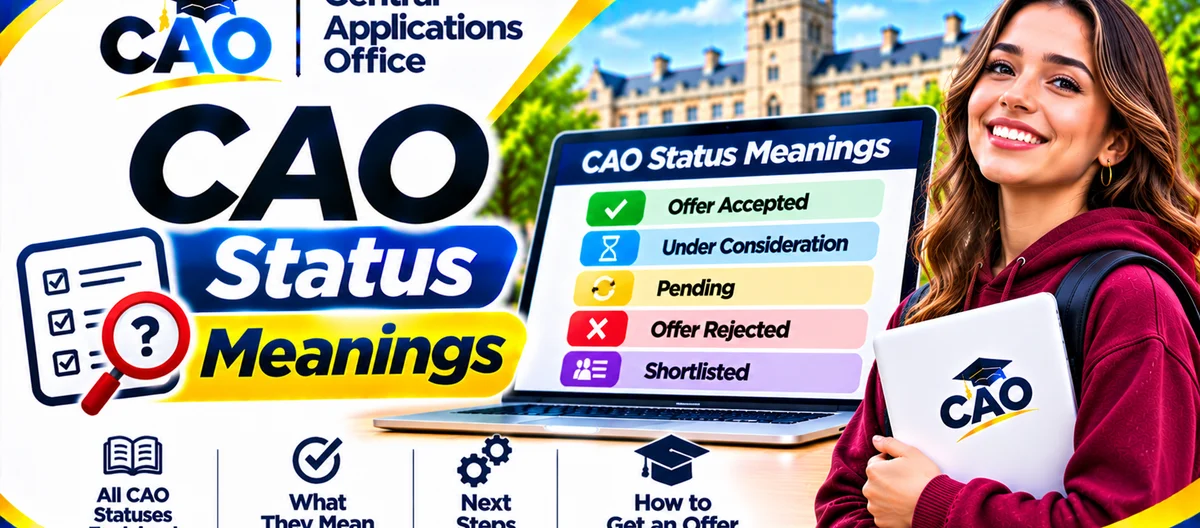
- Look at your other choices One unsuccessful choice does not wipe out the rest. Another choice might still read Waiting for a Decision, Awaiting Results, Short-listed, or even an offer.
- Ask the institution if you need clarity Selection decisions sit with institutions, so they are the people to ask what a particular decision rested on. Keep it factual: your CAO number, the programme, and the status wording as shown.
- Think about a Change of Mind CAO calls a Change of Mind a second-chance application: if any of your programme choices came back unsuccessful, you may complete and submit one online. Once it arrives with the full Change of Mind administration fee, your new choices go to the institutions — except the free replacement of a discontinued programme covered above. Before you submit, check the current fee, which programmes are still open, and their closing dates in the CAO 2027 Entry Handbook.
- Pick the new programme with both eyes open Choose a programme whose entry and ranking requirements you genuinely meet, on a campus and in a field you actually want. Swapping to another oversubscribed programme with the same ranking gap is unlikely to change the answer.
- Send in anything still outstanding If any choice is showing a document request, upload it promptly through Upload My Documents. Don't let an outstanding document hold up a new choice too.
- Look past CAO if you have to If no CAO choice comes through, a future application cycle, a TVET college route, or a direct application where an institution takes one are all still on the table. One cycle's result does not fix your options for good.
- Keep funding apart from admission CAO does not decide NSFAS funding. If you need funding, apply to NSFAS directly — and don't assume an unsuccessful CAO decision changes a funding decision, or the other way round.
What not to do
- Don't lodge a second CAO application to replace an unsuccessful choice. Change of Mind is the official way to change choices.
- Don't send an acceptance or a payment to CAO for a programme that has not offered you a place.
- Don't share your CAO password, and don't trust anyone who says they can change a decision for a fee.
- Don't let an offer on another choice slide while you query an unsuccessful one. Offers carry institutional deadlines, and a seat can go to someone else if you don't answer in time.