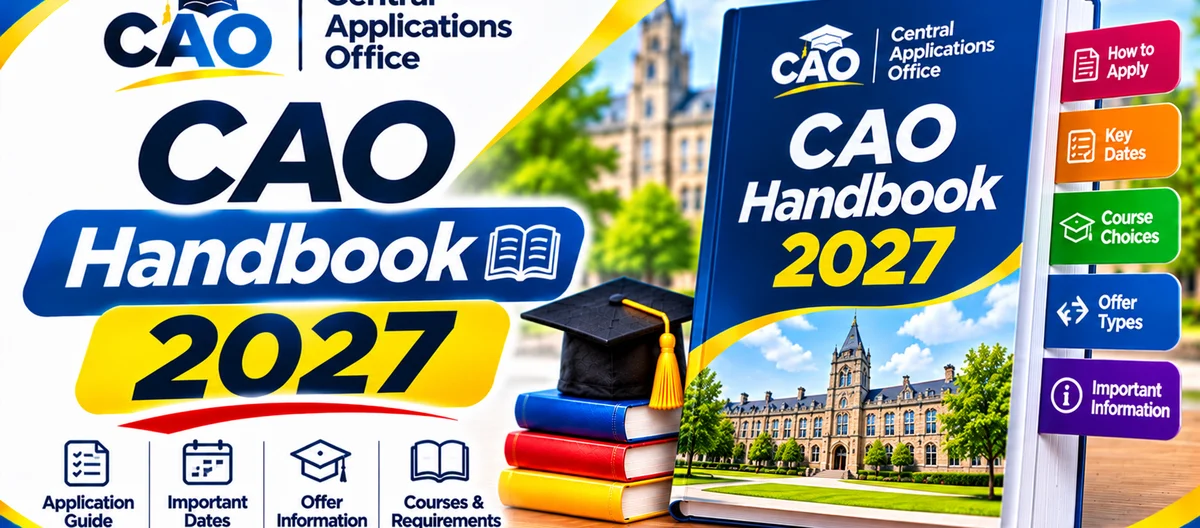
The CAO Handbook 2027 is the programme-by-programme companion for 2027 entry through South Africa's Central Applications Office. What follows shows you what sits inside it, how to put it to work when choosing programmes, how to make sense of a single programme entry, and where to pick up the current version. It also draws the line around what the Handbook cannot do, so you never mistake it for an application form, an offer, or a funding application.
Make sure you are working from the Handbook for 2027 entry, not an older edition. Programme lists, requirements and closing dates move from year to year. A programme from last year might have new requirements this year, might have moved campus, or might be closed for 2027 entry altogether.
What the Handbook Is
At its heart, the Handbook lists the institutions taking part, the programmes they offer, and the entry requirements and closing dates for each one. CAO publishes it for the entry year printed on the cover. For 2027, CAO's Learner Guide notes that the Handbook is available on the CAO website and was in schools from 1 April.
The Handbook and the programme list on cao.ac.za go hand in hand. Think of the programme list as the searchable online version, which you can filter by institution, exam type, working personality or career direction, or by programme name or code. The Handbook is the structured, printable version, arranged by career direction. Whichever you find easier, make sure both point to the same entry year, and always check the programme entry itself before you apply. The two should line up on programme, campus, requirements and closing date. If they seem to disagree, go by the current Handbook entry and, if you are still unsure, ask CAO or the institution which version is right for your programme.
Where to Get the Handbook
Only ever get the Handbook from cao.ac.za. That is the official source. Paying a third party for a download, or trusting a file passed around on social media, is asking for trouble: it could be an older edition, an incomplete copy, or a file meant for a different entry year.
You will not find a direct download link to a Handbook PDF here, because no deep link was verified as the current 2027 Handbook file at the time of writing. Instead, go to cao.ac.za, find the Handbook or 2027 Entry Handbook section, and download the file marked for 2027 entry. If you cannot track it down on the site, phone the CAO Call Centre on 031 268 4444 during the hours given in the verification note.
How the Handbook Is Organised
Inside, the programme choice list is split by career direction, and career directions themselves fall into two sections. Universities and universities of technology sit in the first section, under a blue heading. Private colleges sit in the second, under an orange heading. CAO's Programmes page confirms that colour split.
Finding a programme starts in the Index. Look up the field of study, Sport Science for example, and head straight to the pages it points to. CAO's Programmes page uses pages 249 to 252 as the index pages for its example in the current Handbook, but page numbers can shift between editions, so trust the index in your own 2027 copy rather than numbers copied from another edition. Within each career direction, programmes are grouped by level of study.
The levels you will see are shorter course study, NC(V) study, Nated Certificate and Diploma study (Report 191 Programmes), certificate study, diploma study and degree study. There are also shorter courses and programmes aimed at people already working as educators or nurses. Postgraduate study is a partial story: CAO's Programmes page advises consulting the institution for courses that do not appear on the CAO website or in the Handbook. Never assume every postgraduate programme made it into the Handbook.
How to Read a Programme Entry
Every programme entry packs in what you need to judge whether to apply, and whether you measure up. A typical entry shows:
- Programme name, B Com Accounting for example, with the duration in years where that is shown.
- Programme code, a six-character code tied to one specific programme at one specific campus. The first two characters point to the institution, the third character points to the campus, and the last three characters or numbers point to the programme.
- The closing date for that programme on that campus.
- Minimum points, which is the lowest number of points you can attain to apply for that programme. How many points you need can depend on the school leaving examination you wrote.
- Minimum entry requirements, including the subject levels required for your examination type.
- Entry term, which is the time of year the programme begins. Entry term 1 means first-semester entry, starting between January and February. Entry term 3 means second-semester entry, starting between July and August.
- Course duration, which is the minimum number of months or years of study. Studying part-time takes longer than studying full-time.
- Extra notes, like an interview, audition, portfolio or assessment test, or a programme that prefers applicants who put it first or second.
The colours used for programme names carry meaning too. Pink signals part-time study. Brown signals a new programme still awaiting approval from DHET or Senate when the Handbook went to print. With a brown-coded programme, speak to the institution and confirm it will actually be offered before you lean on it as a choice.
Read the whole entry, not just the name and the points. One programme name can turn up at several campuses, each with its own code, closing date and requirements. A programme can also close early to fit in interviews and assessment tests. And on timing, CAO's Programmes page is clear: applications that arrive after a closing date are processed as late, late applications are handled differently by each institution, and UKZN Health Science programmes do not consider applications received after the closing date.
Using the Handbook to Choose Programmes
Treat the Handbook as a tool for choosing, not just a list to copy. Begin with career directions that fit your interests and strengths, then narrow things down by level of study and by institution and campus. For each programme in the running, write down its closing date, minimum points, subject levels, entry term and duration in a short list of your own. Put programmes side by side and compare them before you rank anything on your application.
Then rank your choices in the order you genuinely prefer them. Some programmes favour applicants who ranked them first or second, and institutions can see where you placed them. A long list of programmes you do not actually want to study buys you nothing. Round it out with at least one honest alternative whose requirements you meet comfortably, so one fiercely competitive programme is not your only hope.
Give subject requirements the same attention you give points. A programme may set a particular level in English, Mathematics, Mathematical Literacy, Physical Sciences or another subject. A strong overall points total will not stand in for a required subject level that is missing, if the programme entry calls for it.
What the Handbook Does Not Do
The Handbook will not submit an application for you, will not guarantee you a place, and will not sort out funding. Meeting the minimum points and subject levels in an entry means you are eligible to apply for that programme. It does not mean a place is yours, because institutions rank applicants and weigh up available places alongside programme-specific selection.
Nor does the Handbook stand in for the application instructions on cao.ac.za. Once you have picked programmes from it, you still have to complete the online application, pay the administration fee shown on cao.ac.za, and upload documents through Upload My Documents. In short, the Handbook tells you what to apply for. The website tells you how to get that application in.
And lastly, the 2027 Handbook does not map out every study route in South Africa. It covers the institutions and programmes that take part in CAO. If your heart is set on an institution outside the CAO system, or a programme that is not listed, go to that institution directly. Trying to squeeze a non-CAO programme into a CAO application will not work.