Think of a CAO status as a short note about a single programme choice — not a verdict on you as a student. Because every institution decides on its own programmes, each choice you made can carry a different status. This page runs through every official status term in the CAO 2027 Entry FAQs, decodes the informal words students usually use, like 'pending', and gives the sensible next step for each status.
Two distinctions will save you confusion later. First, CAO takes in and passes on applications; the institutions — UKZN, DUT, MUT and UNIZULU, along with participating private institutions — make the selection calls. Second, checking a status is not the same as logging in to run your application. The 'Check My Application' checker asks for just one identifier: your CAO number, your South African ID number, or your passport number — no password in that flow. The separate applicant login pairs your CAO number with a password. Never hand your password to anyone.
How to check your status first
- Open cao.ac.za and choose 'Check My Application'.
- Pick one identifier: CAO number, South African ID number, or passport number.
- Type that one number in exactly as it shows on your application.
- Submit, then read the status beside each programme choice on its own.
- Read the whole message for that choice, not just the short label. It may ask you for a document, tell you to contact an institution, or ask you to answer an offer.
A status that has not moved is not, on its own, a sign of an error. Institutions decide at different times through the year, and applying early can mean hearing earlier. No verified fixed waiting time covers every programme and applicant. If you suspect a message went missing, check your contact details and your email and SMS inbox.
Student wording versus official wording
Everyday student language often doesn't match the official labels. The table below lines up the phrases students use most with the official terms they usually point to. When you contact an institution or CAO, use the official term — that is the wording they will recognise.
| What students often say | Official CAO term it usually refers to | Why the distinction matters |
|---|---|---|
| Pending | Waiting for a Decision | 'Pending' is not an official label; in most cases it means the institution has not looked at that choice yet. |
| Provisionally accepted | Conditional Offer | A conditional offer is still open-ended — you have requirements left to meet. |
| Accepted / firm acceptance | Firm Offer | A firm offer is a real offer of a place, yet it can still fall away if you don't accept it, or if your final results come in weaker than your earlier ones. |
| Waitlisted / on standby | Short-listed / Standby / Wait-listed | You are still in the running, with no offer and no refusal yet. |
| Rejected / regretted | Regret Unsuccessful, or another regret message | The precise regret wording matters, because the next step changes — a discontinued programme, for instance, is a different situation from missing a ranking bar. |
| Incomplete application | A request for a document or information — Please Supply Academic Record is one example. | 'Incomplete' does not appear as an official status label in the 2027 FAQs list; look for the exact request shown on your record. |
| Applications closed | Late Application, or a programme no longer being offered | The 2027 FAQs status list has no separate 'Applications Closed' entry, so read the full message and the programme's closing information before jumping to conclusions about what it means. |
Don't take it for granted that every university words its own letters identically. CAO terms are the shared Handbook terms, but an institution's letter can add its own instructions, deadlines and conditions — where it gives you a specific instruction, follow that letter.
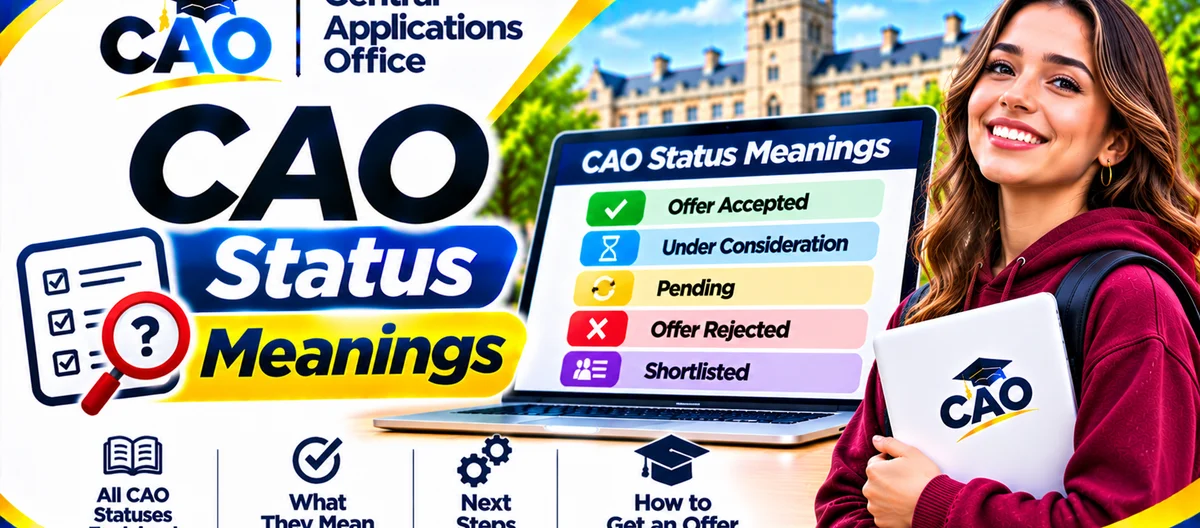
The complete status list
Waiting for a Decision
The institution has not looked at your application for that programme yet. For applications sent in on time, this is where most choices start. It does not mean your application is lost, and it does not mean you have been refused.
What to do: check in regularly, keep your contact details current, and send in any documents asked for. Don't lodge a duplicate application just because this status has not moved.
Late Application
Your application reached the institution after that programme's closing date. Institutions handle late applications in their own ways, so what happens next depends on the institution and the programme. The CAO 2027 Entry FAQs send applicants to the institution's prospectus for more detail.
What to do: look the programme up in the CAO 2027 Entry Handbook, find out whether it still takes late applications, and speak to the institution directly if anything is unclear.
Awaiting Results
The institution is holding its decision until further results arrive — June or Trial results, or final National Senior Certificate (NSC) results, for example. Grade 12 applicants see this often while final results are still to come, and it is not a refusal.
What to do: get your results to the institution by the right route, and upload any statement of results requested. If Department of Basic Education information does not line up with your application, answer that specific message.
Conditional Offer
The institution will take you on condition that you meet the requirements. Where seats are tight, those requirements can sit above the minimum published for the programme in the Handbook. Some programmes also run assessment tests at registration. A conditional offer falls away if you don't signal that you want the place, or if your final results come in below your earlier ones.
What to do: read the institution's letter or message from start to finish, note each condition, and reply inside any deadline the institution sets. Keep working towards the marks required, and don't treat a conditional offer as a done deal. If a condition puzzles you, ask the institution — it set the condition, not CAO.
Firm Offer
The institution is offering you a place. That is the most positive status there is, but it is not unconditional in every case: ignore its acceptance signal, or finish with weaker final results than earlier ones, and it can still be withdrawn.
What to do: accept or turn down the offer directly with the institution, using the procedure and deadline in its letter or message. Never pay an acceptance fee to CAO. Most institutions charge a non-refundable Acceptance of Offer fee to hold the place, which usually counts towards registration and tuition fees — but the amount, the payment method and the deadline all come from the institution, so confirm them with the institution itself.
Has Not Met Programme Ranking Criteria
You fall short of that programme's own criteria. The CAO 2027 Entry FAQs send applicants to the institution's prospectus for more detail, and note that a Change of Mind request lets you change the programme ranking.
What to do: start by checking the programme's entry and ranking criteria in the Handbook or prospectus, before assuming a mistake was made. Meeting a published minimum is no guarantee of admission, since seats are limited and applications often outnumber them. Then weigh whether a Change of Mind to another programme makes sense, and check the current Change of Mind rules and fee before you send one in.
Interview, Audition or Portfolio — listed in the FAQs as Entrance Test and Interview
A few programmes select applicants in special ways. The institution should get in touch with the date, time and venue, and you may need to follow up with the institution directly.
What to do: watch email and SMS closely, keep the date and venue somewhere safe, and prepare precisely what the institution asks for — an interview, an audition piece, a portfolio, or an entrance or placement test. If the selection period is already running and you have heard nothing, contact the institution directly instead of waiting quietly until the chance passes.
Please Supply Academic Record
The institution needs a copy of your academic record from study you are doing now, or have done before, at tertiary level. This is a request for a document, not a decision on your application.
What to do: upload a clear copy through the official 'Upload My Documents' route on cao.ac.za, and confirm it was accepted. Until the record arrives and is reviewed, the institution may not be able to take your application further.
Please Supply USAf/SAQA Evaluation
The institution needs a Universities South Africa (USAf) or South African Qualifications Authority (SAQA) evaluation of foreign examination results you may have written. This comes up when your school-leaving qualification was earned outside South Africa and has to be assessed for comparability.
What to do: apply for the evaluation through USAf or SAQA as directed, and upload it when you have it. Get going as soon as the status shows, because this process can take a while.
Refer for Decision
You are being asked to contact the institution. Put simply, the file needs direct follow-up with the institution before the status can move.
What to do: contact the institution named for that programme choice, give your CAO number and programme, and ask what is still outstanding. The decision sits with the institution, so contacting CAO on its own will not shift it.
Applications Closed — what this wording usually means
'Applications Closed' is a phrase students use, and it can also show up in general programme information — but section 10.11 of the CAO 2027 Entry FAQs does not list it as its own status entry. Wording about a programme being closed may mean its closing date has passed and your application counts as a Late Application, or that the programme is no longer on offer, which is covered by Regret Programme Discontinued below.
What to do: check the programme in the CAO 2027 Entry Handbook or Available Programmes list, note the closing date that applied to that programme, and ask the institution whether any late-application route exists. Don't invent a new closing date, and don't assume a programme closed on one campus is closed everywhere.
Regret Programme Discontinued
The institution has decided to stop offering a programme that was listed in the Handbook at first. In some cases institutions point applicants to an alternative programme. The FAQs state that you may complete a Change of Mind online at no cost to yourself to replace this programme, while any other changes will attract the Change of Mind administration fee.
What to do: if the institution puts forward an alternative, consider it carefully, then use the free replacement Change of Mind route for that discontinued programme only. Check the replacement programme's requirements and closing status before you submit the change, and keep the confirmation of your Change of Mind.
Regret Unsuccessful
The institution has decided against offering you a place, for whatever reason under its selection processes. This closes that programme choice for good — it is not a call for more documents.
What to do: read the message for that choice, look over your other programme choices, and weigh a Change of Mind towards a programme still taking applicants that fits your results. You can also contact the institution directly for more detail, but remember that meeting a published minimum does not guarantee a place when applications outnumber seats.
Short-listed, Standby and Wait-listed
The institution is still considering your application and has not decided whether it will be able to offer you a place. You sit in between: no offer yet, no refusal either. Places can open if other applicants turn offers down or miss their conditions, but that is never guaranteed.
What to do: keep checking your status, answer any message from the institution promptly, and keep realistic alternatives in play. Don't drop your other choices while you wait, and don't pay anyone who promises to push you up a waiting list — no such payment belongs to the official CAO process the FAQs describe.
Unsuccessful Following Placement Test or Interview
The institution has decided against offering you a place after the entrance test you wrote or the interview you attended. The FAQs also note that institutions have a number of wordings for saying they cannot offer you a place, so the exact wording on your record counts.
What to do: accept that this decision belongs to that programme choice and that selection process, look at your remaining choices, and consider a Change of Mind or a future application cycle if that fits. If you think an admin slip happened — your test or interview attendance was not recorded, for example — raise it with the institution directly, with whatever proof you have.
Common mistakes to avoid
- Treating 'pending' as an official status and hunting for a 'pending' button or form that does not exist.
- Sending an acceptance, a payment or a document to CAO when the institution asked for it — above all an acceptance fee, which must never be paid to CAO.
- Taking a conditional offer as final, or assuming a firm offer cannot be withdrawn if you ignore its deadline.
- Putting in a duplicate application instead of following up a document request or a Refer for Decision message.
- Giving your CAO password to someone else, or paying a third party who claims they can check or change your private record.
How long does CAO take to respond?
There is no one verified answer. Institutions decide at different times through the year, and timing turns on the institution, the programme, whether results or tests are still outstanding, and how early you applied. A status still reading Waiting for a Decision or Awaiting Results usually means the decision process is still running — not that something went wrong. If your status asks you to supply a document or contact an institution, act on that specific message rather than waiting for a general reply. Choices often differ from each other: one can show a Firm Offer while another still shows Waiting for a Decision, because institutions decide at different times. Answer any document request first, reply to any offer by the institution's deadline, and only then think about a Change of Mind.