Seeing Conditional Offer on your CAO status can feel like good news with a catch — and that is exactly what it is. An institution has picked you, but the place only becomes yours once you meet the requirements it set and tell the institution you want it. Here is what those conditions usually look like, so you know what to do next and what could still go wrong.
CAO does not choose who gets in. The institution behind the programme — UKZN, DUT, MUT or UNIZULU, for example — makes the call, and CAO simply passes it on to you. So the conditions, and any date you need to reply by, come from that institution's own letter or message, not from CAO.
What a Conditional Offer means
The CAO 2027 Entry FAQs put it this way: the institution will accept you provided that you meet the requirements. Where places are tight, those requirements can sit above the minimum published in the Handbook for that programme. A few programmes also run assessment tests at registration.
Most often, the condition is your final school results. The institution may have looked at your Grade 11, June or Trial results and offered you a place on the understanding that your final National Senior Certificate (NSC) results back up that level. Other conditions might be a particular subject result, a portfolio or test result, or a document it still needs from you. Because conditions change from one programme and institution to the next, your own letter is the only reliable list — no general page can spell out your personal conditions.
What can withdraw a Conditional Offer?
Two warnings in that official definition deserve your full attention. Your conditional offer can be taken away if you never say you want the place, or if your final results come in weaker than the earlier results the offer was based on.
Think of those as two separate dangers. First, silence. If the institution sets a reply date and you let it pass, it may hand the place to someone else. Second, results. Even a quick reply will not save the offer if your final results drop below the level required. Neither result happens automatically in every case, and CAO does not decide either one. If your results land on the borderline, phone or message the institution as soon as you know them and ask what happens next, instead of assuming the offer is still safe.
How do I accept a CAO conditional offer?
Your reply goes to the institution, not to CAO. The CAO 2027 Entry FAQs spell this out: you must tell the institution, and not CAO, whether you want the offer. Its letter or message should set out the steps you need to follow.
Take them in this order:
- Read the institution's letter or message from start to finish. Mark every condition, every document it asks for, and any reply date.
- Check that the programme, campus and starting term in the offer match the choice you actually made. If something looks off, raise it with the institution before you accept.
- Reply the way the institution asks — a reply form, its own portal, an email address, or an in-person step named in the letter. Checking your CAO status on its own does not count as accepting.
- If the institution asks for a non-refundable Acceptance of Offer fee, pay that institution, in the way and by the date it gives. Never send this payment to CAO. The FAQs say this fee usually goes towards your registration and tuition fees, but they give no single amount for everyone, so confirm your amount with the institution.
- Hold on to proof of your reply and any payment — a reference number, a confirmation email, or a receipt. If anyone later questions whether you accepted in time, that proof is what backs you up.
- Keep meeting the conditions. While final results are still to come, make sure they reach the institution through the right channel, then check your status again once results are out.
Changed your mind? Tell the institution directly too. That releases the place for another applicant and leaves your record clean.
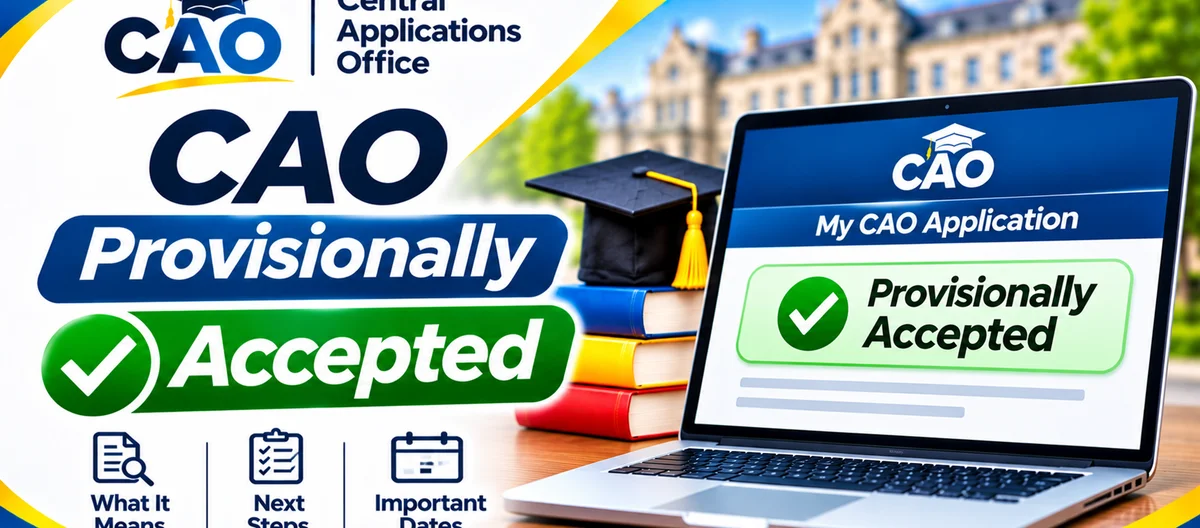
Conditional Offer versus Firm Offer
A Firm Offer is a place offered without that same “provided you meet the requirements” condition attached in the same way. Even so, a firm offer can still be withdrawn if you do not say you accept, or if your final results are weaker than your earlier results, so it still needs a quick reply. The real difference is simple: with a conditional offer, a stated hurdle still stands in front of you; with a firm offer, the place is yours to claim, as long as you answer and your final results hold up. Either way, keep checking your messages.
What if I have more than one offer?
You can hold offers for different programme choices, and each institution may set a different reply date. Lay the programmes, campuses, conditions and dates side by side and answer each institution by its own date. Saying yes to one does not automatically cancel another, and saying no to one does not automatically lock in another, so judge each letter on its own. If you are not sure whether accepting one affects another choice, ask that institution before you reply.
Common mistakes
- Thinking “provisionally accepted” means you are already registered. You are not — registration only happens once you complete the institution's registration process after acceptance.
- Sending your reply or your acceptance fee to CAO instead of the institution.
- Letting the institution's reply date slip by while you wait for another CAO message.
- Easing off on schoolwork after a conditional offer, when your final results are exactly what the offer rests on.
- Overlooking a document request that came with the offer, such as an academic record or an evaluation, and then finding the offer cannot go ahead.